The Roland JP 8000 is one of the most iconic virtual analog synthesizers ever made. Released in the late nineteen nineties, it shaped entire genres especially trance progressive house and early EDM thanks to its legendary Supersaw oscillator.
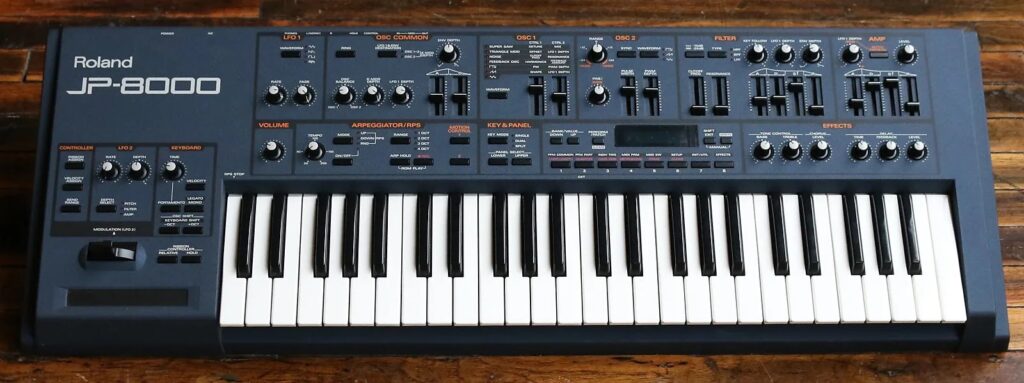
Today original hardware units are expensive rare and increasingly difficult to maintain.
This is where JE 8086 by The Usual Suspects comes in.
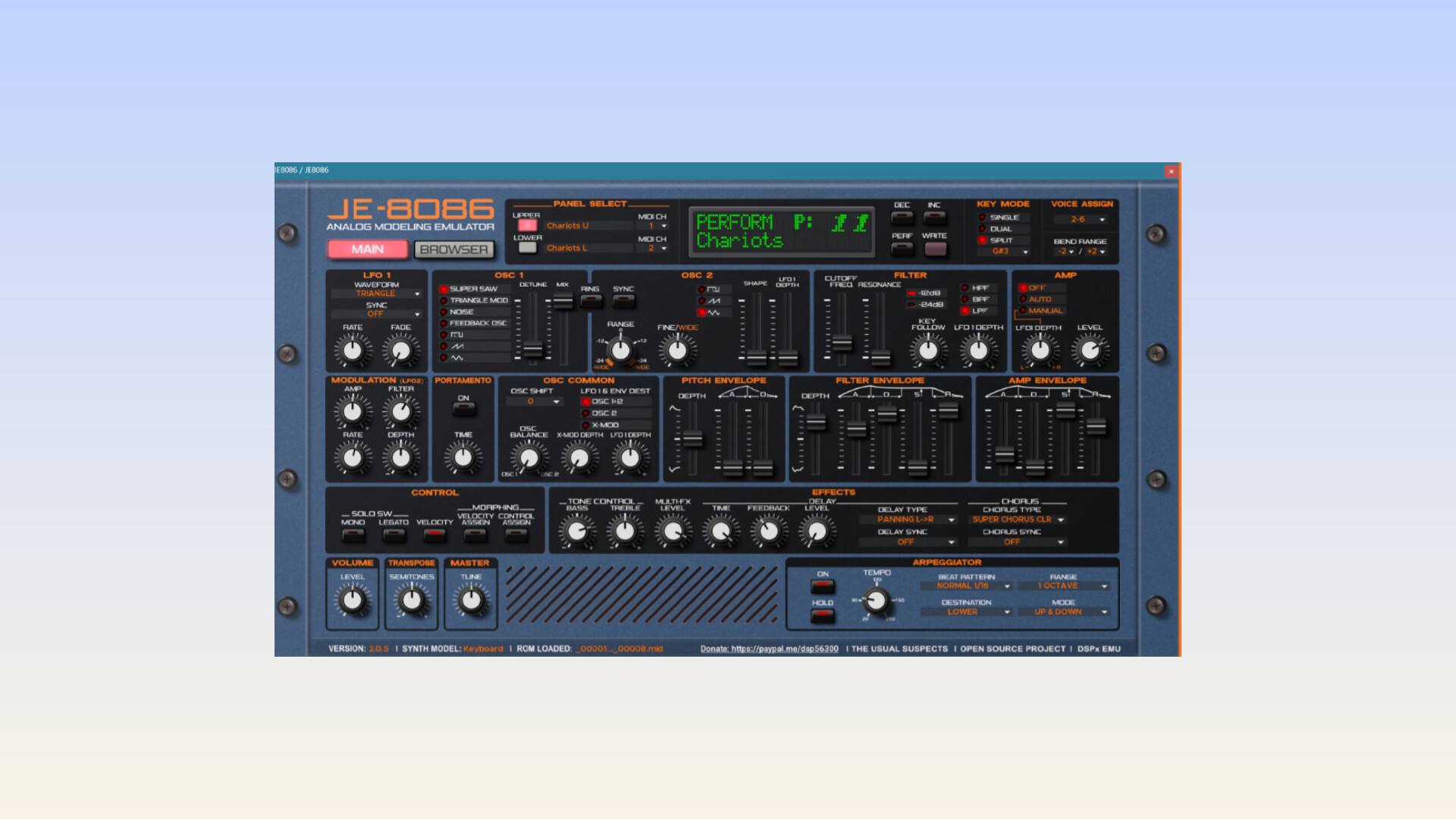
JE 8086 is not just another JP style synth inspired by the original. Instead it is a hardware accurate emulator designed to recreate the actual behavior of the Roland JP 8000 and JP 8080 at a deep technical level. In this article we will explore what JE 8086 is how it works what makes it special and whether it is worth using in modern music production.
JE 8086 is a software synthesizer developed by The Usual Suspects a group known for detailed hardware emulation projects. Rather than approximating the sound with modern DSP techniques JE 8086 focuses on cycle accurate emulation meaning it recreates the original synth internal behavior as closely as possible.
The plugin emulates the Roland JP 8000 and JP 8080 including its oscillators filters envelopes modulation and overall signal flow. The goal is not convenience or flashy interface features but authentic sound and behavior.
One important thing to understand is that JE 8086 does not ship with Roland firmware. Instead it requires users to load their own legally obtained ROM from the original hardware.
Many modern synth plugins claim to recreate classic hardware but most are inspired recreations rather than true emulations. JE 8086 takes a different approach.
It runs the original firmware logic meaning the way parameters interact how envelopes respond and how oscillators behave under modulation closely mirrors the real JP 8000. This is similar to how console or arcade emulators work by reproducing the system itself rather than rebuilding it from scratch.
This approach is one of the main reasons JE 8086 stands out especially for producers who want the exact JP sound not just something close enough.
One of the standout features of JE 8086 is its dual part design. Inside a single plugin instance you get Part A & Part B, Each part functions as a full JP style synthesizer. These parts can be used independently layered for thicker sounds or assigned to different MIDI channels. This makes JE 8086 especially powerful for massive supersaw stacks layered pads and leads and complex trance patches. Compared to many modern soft synths that require multiple plugin instances for layering JE 8086 keeps everything inside one interface just like the original hardware concept.
You cannot talk about the JP 8000 without talking about the Supersaw. The Supersaw oscillator defined the sound of late nineteen nineties and early two thousands dance music. Its wide detuned character became the backbone of trance anthems and festival leads.
When paired with the correct ROM the Supersaw in JE 8086 delivers the classic JP thickness and movement that many modern synths struggle to replicate accurately. Filters Envelopes and Modulation Beyond oscillators JE 8086 captures the subtleties of the JP 8000 synthesis engine.
Classic Roland style filter response
Smooth resonance
Musical cutoff behavior especially under automation
Hardware accurate envelope timing
Natural response when shaping plucks pads and evolving leads
Authentic modulation routing
Classic LFO behavior
Parameter interactions that behave like the original synth
These details matter especially when recreating classic patches or designing sounds that respond musically over time.
JE 8086 is available in modern plugin formats including
VST2
VST3
AU
CLAP
It supports
Windows
macOS
Linux
This makes it compatible with most major DAWs including FL Studio Ableton Live Bitwig and Logic Pro.
A key point that often confuses new users is the ROM requirement.
JE 8086 does not include Roland firmware. You must own a Roland JP 8000 or JP 8080 and dump the ROM yourself or use a legally obtained ROM dump.
This approach allows developers to avoid copyright issues while still delivering an authentic emulation. While this adds an extra step during setup it is a small trade off for the level of accuracy JE 8086 offers.
Because JE 8086 runs an emulated system it can be more CPU intensive than lightweight virtual analog synths. However modern systems handle it well especially when used responsibly.
Best practices include freezing or bouncing tracks after sound design using one instance with layered parts instead of many instances and adjusting buffer size if needed.
In return you get authentic sound and full DAW integration including automation and total recall.
JE 8086 is ideal for trance and progressive producers retro and nineteen nineties electronic music fans sound designers seeking authentic JP 8000 behavior and producers who value accuracy over convenience.
It may not be the best choice if you want a quick lightweight synth do not want to deal with ROM files or prefer modern wavetable or FM workflows.
JE 8086 by The Usual Suspects is one of the most authentic JP 8000 emulations available today. Its cycle accurate approach dual part architecture and faithful Supersaw recreation make it a powerful tool for producers chasing classic Roland virtual analog sound.
While the ROM requirement and higher CPU usage may not appeal to everyone those willing to invest a little extra effort are rewarded with a plugin that delivers true hardware character inside a modern DAW.
And it’s free I don’t know if I mentioned that…lol, it is not a light weight synth plugin and that’s just something you and I have to deal with.
If you are serious about classic trance tones lush supersaws and authentic late nineteen nineties synthesis JE 8086 is absolutely worth exploring.
IF you want to try another cool synth plugin check out Zebralette 3 by uhe